

Wartime Memories
Home Guard Tom Moore on right
Photograph: The Joe Moore Collection

The Sunday School block of the Free Church after the bombing of 1940
Over the last 16 years many memories of wartime have been recorded by Kirby Muxloe History Group. Often meeting people in the village and sometimes by travelling to visit interested people in their homes, some miles away. Many of these memories are from people who have now sadly passed away, however, they were all very happy to share their recollections of this event as it has never truly disappeared from their memory.
Below we share the stories of some of the people who were interviewed; they were often small children or at most teenagers at the time. We now have few people left who remember this harrowing time, but those that are still alive today have very strong memories, never to be forgotten.
The memories of Peter and Pam Cooper
The Sunday School block of the Free church after the bombing of 1950
Peter Cooper - in his own words:
In November 1940, I was living with my parents, brother Bill, and sister Kathleen, in a house on Main Street, built for us by Newman's the builder.
On the night of the bombing, mum, my sister Kathleen and I went down tho the shelter when the sirens went off. Early on in the war four neighbours, including my family and the Rowe family, got together to build an air raid shelter. They cut into the bank a the bottom of the gardens and built one out of concrete. It had electricity and bunk beds. Every time the siren sounded Mr and Mrs Rowe plugged in the lights and we went down a few steps into the shelter. We sat around a paraffin heater and brought flasks so that we could have a hot drink. The blankets were always damp and the whole place smelt of paraffin, but we felt reasonably safe. After the bombing of 19th November we went down to the shelter every night until the end of the war.
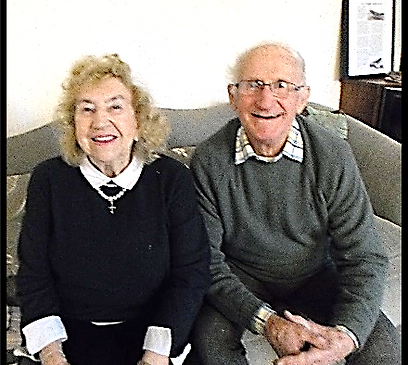
Peter and Pam Cooper photograph 2018
On the night of the bombing, mum, my sister Kathleen and I went down to the shelter when the sirens went off; my brother Bill was working in the pit at Desford so dad stayed behind to get his tea. Suddenly there was this massive crash, dad and Bill came straight down to the shelter telling us that the conservatory roof had been blown off! We stayed in the shelter until the next morning.
On the morning of the 20th, the day after the bombing, we were still expected to go to school as usual. We had to catch a bus to Gateway School in Leicester. As we walked up to the bus stop we saw mud, debris, glass and tiles everywhere. A gas main had burst next to the Free Church. That morning it was chaos, the bus couldn't get along the road, but we knew we had to get to school somehow. We had to take a letter to school to explain why we were late.
The corner house on Church Road belonged to Mr and Mrs Worker - they were the local fishmongers, going around the streets ringing their bell to alert customers who wanted to buy fish. The front of their house had been blown down. They had a lot of sovereigns, which they kept under the bed, they were everywhere! Luckily the A.R.P. Warden collected them up, putting them into a tin bath.
Although the war went on for a number of years, we always thought that we were going to win. It never occured to us that we wouldn't be o.k. in the end.
Pam Cooper - in her own words
In 1940 I was living with my family at 72, Desford Road. My father was in the A.F.S. (Auxiliary Fire Service); my aunt and uncle, Mr and Mrs Worth had a drapery shop, which had been built for them, next to the school on Barwell Road. On the evening of 19th November 1940, my father and uncle were out travelling (they visited several villages with their drapery business), I was at dancing classes at St Bart's Sunday School, Miss Swain was our teacher. When we heard the siren go off, Miss Swain said "we'd better get you home". We started walking along Main Street towards Station Road and then stopped in front of the Free Church, (just 10 minutes later the bomb dropped on the Free Church). Miss Swain's father came along in his lorry and said he must get us home as quickly as possible, so we jumped into his lorry and drove down Hedgerow Lane and around the corner to Desford Road where my mother was waiting for me. We could hear the distinctive sound of the German planes in the sky above. My aunt Dorrie, who owned the drapery shop had given me some ribbons, they were on the dressing table so I ran upstairs to get them. The dressing table was in an almost straight line from the Free Church - I heard a dreadful explosion and saw the Free Church go up! I remember the force knocked me back onto the bed, the tiles had come off the roof and all the windows had been blown in. I ran downstairs still holding the ribbons, the house was rocking! My mother said "the swine's", the worst words she had ever spoken. During that evening, amidst all the noise and confusion, my two cats Whiskey and Tim stayed asleep curled up on my bed.
Connie Stevenson 1925-2020
By the time I had finished school, WWII had begun. I was sent to Louth Infirmary for training to be a nurse. I had never been away from home before, but dad took me to the station and I was lucky enough to meet a girl who was going for the same training course. We became friends and stayed in digs together whilst we did our training, which lasted about six weeks. I became a member of the Civil Nursing Reserve and worked at Hillcrest, which was a home for the elderly, but also a hospital for wounded soldiers. We took the overflow from the City General Hospital. I also worked at Market Bosworth Hospital, again caring for wounded soldiers. After that, I married, and as was the normal thing to do in those days, stayed at home to look after the house. The Bombs I remember the night of the bombing very clearly. It was certainly a night to remember. My brother had tonsillitis and we were both lying on the sofa, keeping warm by the fire. My dad was in the Home Guard and was out on his rounds. There was a terrific bang and the windows shook, mum shouted "All the windows have gone", there was chaos! A bus had stopped at the end of Princess Drive. If it had carried on up the hill many lives would have been lost. My aunt Dorrie ran a shop that sold materials (now a nursery) on Barwell road. I used to help out in the shop by delivering goods to customers. I went off on my bike with the deliveries tied to the back. I think the furthest I went was to the farms on Desford Road. The morning after the bombing we could see all the shop windows had been blown out and some of the mannequin heads, on which hats were displayed were rolling down the road. Some people had quite a fright until they realised what they were. the roofs on the houses on Barwell Road seemed to be hanging over the front of the buildings.
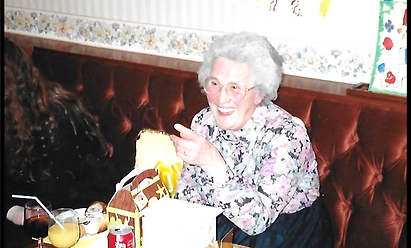
Connie Stevenson photographed in 2018
Martin Freeman 1935-2022
On the night of the bombing we heard planes overhead, we never knew if they were enemy planes or the R.A.F. When the bombs dropped my mother pushed us all under the stairs, my brother was one and a half years old, he slept through the whole time. The space under the stairs was very tiny, I don't think my mother was in there as well as it was too small. I remember that the whole house shook, and the windows rattled. I could hear my father banging on the front door, trying to get into the house, but mother couldn't let him in as the door was jammed due to the explosion. I felt frightened especially when we heard the explosion, we thought they had bombed our house! Sometime later we came out from under the stairs.
There were more planes going over later in the evening, we thought they were Germans but my mother said "no it's the RAF chasing the Germans away. After the bombing my father built a shelter in the garden, it had treble thickness walls with a concrete lining and a steel door. The Wilshere's next door already had an underground shelter.
The next day my father took us all down to the village to see the destruction-it was a shock! The Free Church had been flattened
and the adjacent houses, a the top of Church Road were badly damaged. Half the houses had gone and all the rooms were exposed, particularly the bathroom and bedrooms. I remember my mother saying "look at that wallpaper I wouldn't have that in my house". The whole of Main Street was covered in slates and tiles, the police were there and the gas people were there also, trying to seal the gas leak as quickly as they could.
I remember a fund raising fete at the Reccy (recreation ground, now referred to as 'the park'); there was a coconut shy with images of Hitler, Goering and Goebbels, looking absolutely evil! We had to hit them down with tennis balls to win, I knocked down Hitler and won a prize.
I recall people used to say that a parachute bomb landed near to the 6th hole on the golf course. There is a big dip in the fairway at that point, as the 6th hole is quite near the Gullet Lane bridge. Could that be the unexploded bomb mentioned in the A.R.P.'s warden's report?
Memories - Joy Hawke 1932-2023
I remember the night of the bombing, even though I was only seven years old. I was at dancing class with many of my friends in the Parish Hall on Main Street. I recall being met out of class by my father and told we had to get home quickly. I felt quite concerned but we reached home safely so everything was alright. For safety I was put under the stairs, where there were some supplies and a divan bed. Dad thought he would finish off the rice pudding left over from earlier in the day, and opened the oven door which was just over the coal fire to get it. As he walked out of the kitchen holding the dish of rice pudding, the bombs dropped. There was a terrific blast, and the suction from the bombs pulled out some of the windows. This was followed by the clothes horse full of clean washing, which landed in the garden when the back door blew open. We didn't bother to pick up the washing that night but collected it from the garden the next morning, it was wet and dirty! We only missed the bombing by a short time and were very lucky to have survived. My father was an A.R.P. First Aider and as soon as the bombs dropped, he picked up his kit and left the house immediately. We didn't see him for several hours and when he came back he brought Miss Wilson with him; she was an elderly lady who was not in good health and lived nearby. Miss Wilson was so glad she didn't have to go into the shelter on the Recreation Ground, as apart from being ill, she was suffering from shock. Miss Wilson lived at number 15., Main Street and sadly her house had to be demolished. After the blast, it started to rain and everywhere was getting very muddy. My mother seemed to be boiling kettles of water all night, as we had a coal fire, most people had gas and as the gas main had been blown out there was no fuel. What a commotion, people were wandering or rushing around in the dark and the rain. However there were still moments of 'normality'; my father was most amused when taking a homeless person into a nearby house, he was told to "wipe your boots"!
_JPG.jpg)
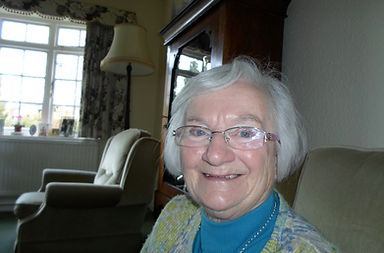
The late Joy Hawke in 2014
Tom Kelsey 1925 - 2011
Tom Kelsey spent his early years living in Kirby Muxloe and then after living for a time in Blaby he emigrated to Australia. Tom was an avid ornithologist/twitcher. He is pictured here with a reference book and some bird specimens.
During the few days prior to the mine dropping, I was covered with a rash and Dr Jones couldn't be sure that it wasn't scarlet fever. On the night of the mine dropping, mother made me a bed under the backroom table.
After the explosion, our backroom was left in a fair condition with only broken glass around. In the morning, my rash and condition had improved, so I was out with the boys, hunting for souvenirs. I found a piece of parachute cord which I still have today. In fact, I made my daughter a rocking horse; guess what I used for the tail! A thick length of parachute cord.
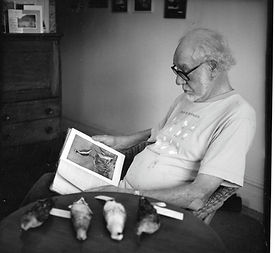
Tom Kelsey at home in Australia
Violet Thirlwell 1920-2014
Number 1, Church Road was almost demolished by the landmine. Luckily for us with dad building 'Sandy Mount' on Desford Road, we had moved into the new house several months before the bombing. Dad had let the house to the Spare family, who miraculously, although in the house, were not too badly hurt! A bookcase landed on Mrs Spare, but although covered in glass she was fortunate to escape lightly. On the night of the bombing, I remember it was early evening so we hadn't gone to the shelters, and no warning had been given-we were in the kitchen, mum was ironing, and there was a terrific bang! I remember just after the bang, dad said "where's mum"? - we couldn't find her. We went outside and discovered her running around the garden with the clothes horse; she meant to save the newly ironed clothes at all cost.
We were a distance away from the badly bombed area, so it wasn't until the next morning we were able to see the extent of the damage, in Church Road, Castle Road and Main Street. We couldn't believe it, so much damage. Number 1, Church Road was demolished and re-built a few years later.
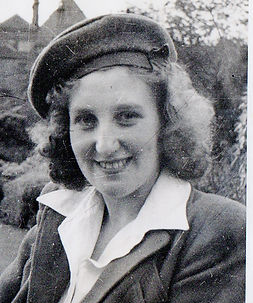
Violet Thirlwell
Geoffrey Spare 1924-2022
At the time of the bombing I was 16 years old. Our home at Kirby Muxloe was in Church Road, next to the Free Church. I was finishing my meal after working later than usual, so it would have been around 8.00pm. My brother Walter had been watching the raid develop from my bedroom window at the back of the house, when he came downstairs to tell us how much it had intensified. He and I went back upstairs to look again and it was quite obviously getting worse. My eldest brother, Charles, arrived home and joined us looking out. Within minutes Walter suddenly shouted "Look out"! something had lodged on the tree at the bottom of the garden. "Look, it's something on a parachute"! Instinct took over and he turned to the wall away from the window, Charles did likewise on his side. I, being in the middle, dropped below the window. Nothing seemed to happen and all I could think was that someone had bailed out, for at the time I'd never heard of a landmine on a parachute! I got up to look again and as I looked out, there was an almighty explosion. The garden was only about 50 feet long and as the explosion took place, I saw a huge ball of blue-orange flame and heard a noise of absolute bedlam. The next thing I knew, I was lying across my bed! I don't think I lost consciousness, but my senses were all in turmoil. Was I dead? I don't think so - silly thought I know, but that's how it was until my senses came back to normality . I could feel blood on my face and head, but I felt alright and my arms and legs worked. I now heard my sister shouting from downstairs where she had been sitting with my mother. the three of us got downstairs to find a leaded light bookcase had toppled over on to my mother. We managed to free her without further injury. We all then got out into Church Road. The first thing I saw was a hole in the road and the gas main on fire. The glare from that lit up the scene and at a glance, I could see that the Free Church was no longer there. The houses opposite us had the fronts blown away, for I could see directly into the bedrooms etc. The Reverend Caldwell stood in the road and must have been in a complete state of shock, for he stood looking where the Free Church had stood, continually repeating "Oh, my beautiful Church"! He was completely unaware that his sister and mother were trapped in the wreckage of their house and crying out for help! I clambered over the rubble and found them sitting at a table surrounded by fallen masonry, unable to move. I shifted enough to free them and they didn't appear injured at all, so I reunited them with Rev. Caldwell. I then caught up with my family and we made our way to the shelter. We made the rest of the night there before the "All Clear" sounded. Whilst sitting there, I realised there must have been two bombs exploding almost simultaneously. One was in the road and set the gas main on fire and also took the fronts off the houses opposite us. The other one was the one I saw explode in our garden, and would take the Free Church out! When we came out from the shelter, the destruction was almost unbelievable. We made our way back to our house and met Mr and Mrs Wood on the way. They owned our house and they were very concerned for us and insisted we go with them, back to their house for warmth and something to eat and drink. We stayed there most of the day, for we were all very, very tired and shocked. Later we had to go back to the house to try to get some warm clothing and everyday essentials. This we managed, and we then went to live with my married sister and her husband at Thornton until we were able to find another house. I later had a very nice letter from the Reverend Caldwell, thanking me for assisting his mother and sister.
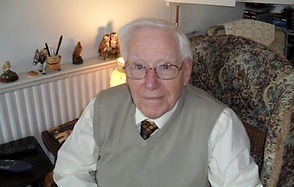
Geoffrey Spare in 2012
The story reads:
Dear Sir
The Rev. J.A. Caldwell tells me that on the night of November 19th, when his house was severely damaged during an air raid, you came to his assistance without any thought for your own safety, succeeded in assisting two ladies to get out of the mess.
He informed me that you are only sixteen years of age and that he considered your action very brave. I am writing, therefore, to congratulate you on your brave action.
It is a splendid thing for you to feel that through your action you materially assisted in relieving the suffering of two ladies who had been badly shocked and injured by bombing and I hope this courageous spirit will prevail in all your future actions.
Yours faithfully
Chief Constable
Stan Garner
I was seven years old when the bombs dropped on the village. I lived at 5, Barwell Road with my mum, Dorothy, my dad Bill (William) and sister Margaret. I was one year nine months older than my sister. The village policeman lived at number 3. Dad was not allowed to go into the armed forces as he had a duodenal ulcer, so he volunteered to join the Home Guard. His friends George Hirons and Harold Hutchinson joined the armed forces. Harold served in the Middle East and George in Burma; George also served time as a prisoner of war. I remember when the Home Guard were having one of their practices, they ran over some allotments and gardens, the villagers were not very pleased! During the war Margaret and I always slept down stairs, I think mum and dad thought we would be safer there. Dad had put chicken wire over all the windows so that if the glass was broken we wouldn't be hurt. That night I was asleep when suddenly there was a big bang! I fell out of bed and my nose started to bleed; I was scared. The windows were blown in but because dad had covered them with chicken wire we were not cut or hurt, we were very lucky! The Free Church had received a direct hit and the force of the explosion had come down through the passageways of the houses on the village side of Barwell Road, and hit the houses on the other side of the road, lifting up the roofs. The blast also lifted the roofs on some of the houses on Church Road. When we went outside the air was thick with dust, we came out of the yard, and past Mrs Percy's house and when we looked up into the sky, I said to my dad "flaming onions"! We could see the planes going overhead on their way to Leicester. We were told to go to a house on Castle Road, it was two or three houses up from Barwell Road. When we arrived, we sat under the stairway until it was safe to come out. We didn't go out to look at the damage in the village the next morning as we were evacuated to Merrylees. I didn't have chance to see much at all! I only stayed at Merrylees for one day, as I didn't like it. I then went to live with my grandma, Mrs Woodward, at 77 Main Street. I stayed there until our house was repaired. Although food was rationed during and after the war, we were never short of meat as we kept chickens and rabbits.

Stan Garner in 216
Bill Hobill 1928-2013
Bill's Story: At the time of the bombing, I was living at Grange Farm, Leicester Forest East, my dad was a Special Constable. We were all having a cup of tea in the kitchen with P.C. Bowley, the local policeman. Suddenly there was a loud noise, the ground seemed to shake, and we thought that a bomb had dropped very near to the farmhouse. My dad put on his special armband and left the house immediately with P.C. Bowley. We heard Mrs Bolton, who lived on Hinckley Road, leave in her ambulance at about the same time. They all went straight down to Kirby to help the injured. The next day I went with friends on bikes to Blood's Hill. We collected pieces of shrapnel and pieces of green parachute material; I still have them today. I remember the airmen at Braunstone airfield, they arrived ready to be trained as pilots, to fly Tiger Moths. Sometimes there would be as many as 24 planes going round and round in the sky above Leicester Forest East. When they came in to land some hit the ground and then bounced back up, about 12 feet, before finally hitting the ground and coming to a standstill. I remember one plane landing on its nose! When their training had been completed they would leave to join their station and another group of trainee pilots would arrive. As so many airmen were coming and going, billets were required to give them somewhere to stay. Mrs Bolton, the ambulance driver used to come along driving a bus full of newly arrived trainee pilots, she would call at the house and ask if there were any bedrooms not in use. I remember we said we had one spare room and so Mrs Bolton replied "ok, you can have 2 then". Airmen were billeted all along the Hinckley Road. Some of them were quiet and calm and some were good for anything, they used to go dancing at "Kirks Hut". Mrs Bolton's ambulance was really old fashioned, it had spokes in the wheels; throughout the war she drove busloads of trainee pilots and the ambulance around, but no one knew that she only had one eye! All over the country the War Ministry had erected concrete walls across the roads, most often at the junction of 2 or more roads; the walls were around 6 feet high and 5 feet wide. They were built like a chicane so that there was enough room for a bus or a lorry to get through but not a tank. They were erected to delay the German tanks, should they arrive. One of these walls had been constructed at the junction of Ratby Lane and Hinckley Road, near to the Co-op, and there was also one near to Kirby corner, (the junction of Glenfield Lane and Main Street). At the beginning of the war the local air raid siren was on the roof of a large house called The Grange. There was an anti-tank gun in the front garden, it was mounted on a round concrete base with a 4 foot trench surrounding it; when the war ended it was demolished, the concrete was used to make farm tracks at Grange Farm. The concrete was transported by horse and cart. At sometime during the war the Grange was demolished, the air raid siren was then moved to the garage opposite the turn from Hinckley road down to Kirby Muxloe. At the time the garage was owned by Mr Moseley and Albert Davey. The land belonging to the Grange was eventually used to build the motel named Forest Park. At the end of the war a few airmen stayed on at Braunstone airfield for a short time, for 10 shillings you could have a trip in a Tiger Moth circling Leicester Forest East and the surrounding area. I was able to do this quite a few times.

Bill Hobill delivering milk circa 1975